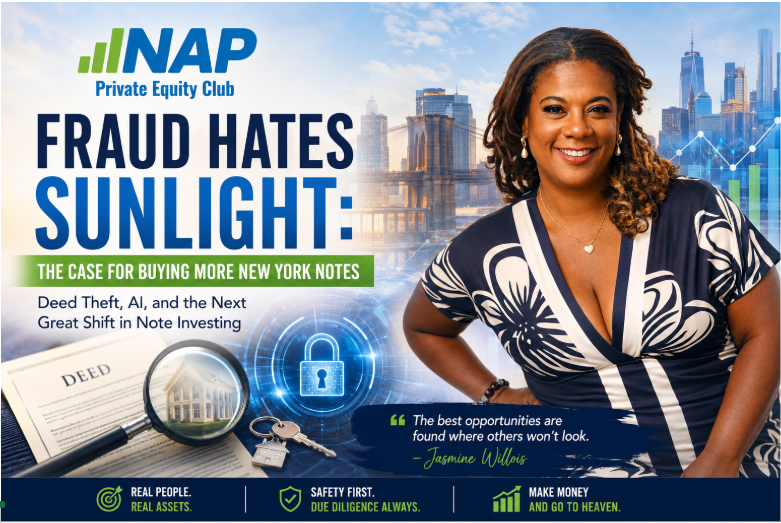
Fraud Hates Sunlight: The Case for Buying More New York Notes
Deed Theft, AI, and the Next Great Shift in Note Investing
Written by Jasmine R. Willois (2026)
Founder, NAP Private Equity Club | Mother to Kojo the Gamer | Host, Naked Notes & NoteTress Network Podcasts
To Buy or Not to Buy New York Notes?
As a native New Yorker, I can tell you that New York—much like Chicago—is not a market for the weak at heart. You need a seasoned team, experienced attorneys, strong servicers, and perhaps most importantly, the mental toughness required to survive some of the longest timelines and most complex workouts in the country.
Over the years, investors have been given plenty of reasons to avoid New York notes: judicial foreclosures, multi-year timelines, expensive legal costs, tenant protections, bankruptcy delays, heirship issues, probate complications, and title defects. If you know, you know.
And yet, NAPNATION continues to buy New York notes.
In fact, as I write this article, we recently sold a Brooklyn asset and are actively working through a foreclosure in the Bronx. New York remains a meaningful part of our business—not because it is easy, but because difficult markets often create tremendous opportunities for investors who are equipped to handle them.
This article focuses on one of the most frightening items on that list: deed fraud.
Among seasoned asset managers, Brooklyn has long carried the nickname “Crooklyn.” While anyone who has spent time in Brooklyn over the last twenty years knows the borough has evolved dramatically, the nickname reflects a very real concern that has followed New York real estate for decades: fraudulent transfers, title disputes, forged deeds, and bad actors looking to profit from other people’s equity.
Truths like these bleed into a larger reality about investing in New York. It is a niche market where locals—and those with the resources, patience, and conviction to navigate complexity—play to win. There is no shortage of capital available in New York. In fact, it remains one of the largest mortgage markets in the country by dollar volume due to the size of its housing market and average loan balances.
New York does not suffer from a shortage of lenders. It suffers from a shortage of investors willing to navigate the complexity.
“Ironically, many of the same factors that scare investors away create opportunity for those with experienced teams. Long timelines, title issues, probate challenges, heirship disputes, and yes, even deed fraud often result in fewer bidders, wider discounts, and less competition.”
That does not mean these assets are easy.
It means they are misunderstood. And misunderstanding is often where opportunity hides.
The best note investors are not necessarily those who avoid risk. Successful investors learn how to identify, price, and manage risk. In my experience, opportunity often exists precisely where others are unwilling to look.
Deed fraud is a perfect example.
Why Brooklyn Became Ground Zero
This is not a new problem in New York or within the real estate industry. Brooklyn became ground zero because it sits at the intersection of generational wealth, heirship issues, and massive appreciation in historically Black neighborhoods.
A 2026 report from the Center for NYC Neighborhoods found that homes worth roughly $400 million are at risk each year from deed theft and predatory title schemes, with Central Brooklyn identified as one of the most vulnerable areas.
And who can forget the disbarred attorney convicted in 2025 of stealing the deeds to eleven Brooklyn properties in a decade-long fraudulent scheme?
But deed theft did not begin there.
Since the 1980s, schemes such as equity stripping and foreclosure rescue scams have targeted Brooklyn due to the substantial appreciation many neighborhoods experienced over multiple generations. Communities once overlooked have undergone dramatic gentrification and value increases. As property values climbed, sophisticated fraudsters increasingly viewed these neighborhoods as fertile ground for schemes designed to capture accumulated equity and generational wealth.
Brooklyn’s rising property values transformed an old title-risk problem into a major financial crime problem.
The 30-Year Evolution of Title Risk in Brooklyn
Today’s deed theft epidemic did not appear overnight. It evolved through decades of foreclosure crises, distressed housing stock, probate complications, and gentrification cycles that Brooklyn has experienced since the 1970s.
1970s–1980s: The Distressed Property Era
During New York City’s fiscal crisis, abandonment, tax foreclosures, and widespread housing distress created significant title issues. Many properties suffered from clouded title, missing heirs, estate complications, and absentee ownership. Fraud existed, but the economics were different—most schemes involved distressed transfers rather than theft of high-value homes.
Late 1980s–1990s: Foreclosure Rescue Schemes
As Brooklyn neighborhoods began stabilizing, scammers targeted homeowners facing foreclosure with pitches like “I can save your house” or “Sign these documents.” Many homeowners unknowingly transferred ownership interests believing they were entering workout agreements.
2000–2010: Property Values Explode
Bedford-Stuyvesant, Crown Heights, Fort Greene, Bushwick, and Prospect Heights experienced rapid appreciation. Properties worth $100,000 in the early 1990s became worth $500,000 to $1 million or more. Criminals targeted decades of accumulated equity and generational wealth.
2010–2020: Deed Theft Becomes a Recognized Crisis
Community groups, legal aid organizations, and prosecutors sounded the alarm. Brooklyn combined rapid gentrification, elderly homeowners, inherited property, and large Black and immigrant homeowner populations.
2022: Statewide Hearings
The New York State Senate held formal hearings examining deed theft across the state, identifying Central Brooklyn as one of the most vulnerable areas.
2023–2024: Major Legislative Response
New York expanded civil protections and formally criminalized deed theft. Attorney General Letitia James described deed theft as a crime that robs families of homes, wealth, and stability.
2025–2026: Full Government Response
Brooklyn prosecutors secured convictions in major deed theft cases, and in April 2026, New York City established the Mayor’s Office of Deed Theft Prevention within the Department of Finance.
New Technology, Evolving Solutions
In response to growing concerns surrounding deed theft and fraudulent conveyances, New York has implemented and proposed measures designed to increase transparency and accountability throughout the ownership transfer process.
State & City Enforcement Measures:
- Enhanced criminal penalties for deed theft and fraudulent transfers
- Expanded powers for prosecutors and enforcement agencies
- Longer statutes of limitation for victims
- Dedicated deed fraud prevention offices and investigative units
- Improved homeowner notification systems
- Greater coordination between recording offices, law enforcement, and consumer protection agencies
- Increased public access to digital property records
At the same time, technology is rapidly transforming the title and servicing industries. Modern investors now benefit from real-time recording data, automated ownership verification tools, digital document tracking, AI-powered title review, and enhanced identity verification.
Ironically, greater transparency may ultimately make New York notes more attractive—not less. As bad actors lose places to hide and title information becomes easier to verify, sophisticated investors may find that the risk-adjusted opportunities in New York become increasingly compelling.
Summary: Know Thy Seller
The time is going to pass anyway. With the right patience, the right pockets, and the proper goal, a New York note or two can set your capital stack right. It can help you catch up on a retirement plan, accelerate a life plan, or create opportunities that simply do not exist elsewhere.
“So the most important takeaway I have is this: Know Thy Seller. In our community, we often joke that this should be the Ninth Covenant of Note Investing. KYS — Know Your Seller.”
Since 2013, when we opened our doors, our motto has been Safety First. In note investing, that means relationships matter. It means when I source notes for our community, there is a relationship behind every trade. It means understanding not just the asset, but the source of the asset. It means reputation matters.
Our core group has invested together for well over five years, and many of us for more than a decade. That level of trust gives investors something most people in this industry never experience: confidence. Too many investors leave this business because they bought from the wrong people, not because they bought the wrong assets.
Technology can help identify fraud, verify ownership, and uncover title defects. But technology cannot replace relationships.
In New York, the title may be complicated, the foreclosure may take years, and the paperwork may be stacked to the ceiling. But if you know the seller, deed fraud is light work.
About the Author
Jasmine Willois is a native New Yorker, keynote speaker, fund manager, and the Founder of NAP Private Equity Club (NAPNATION), one of the largest and most active mortgage note investing communities in the country. Since opening its doors in 2013, NAPNATION members have collectively purchased and invested in more than $1 billion in unpaid principal balance (UPB) across the secondary mortgage market, demonstrating the power of collaboration, education, and disciplined investing.
Jasmine is the President & CEO of US Mortgage Notes, Inc. and Co-Manager of RDMO Fund II, a private equity fund focused on acquiring reverse mortgage assets directly from HUD. She is widely recognized for her expertise in distressed debt, private lending, mortgage note investing, portfolio management, and passive income strategies.
Jasmine is the creator and host of the Naked Notes Podcast, ranked among the top mortgage note investing podcasts in the industry, and co-hosts the NoteTress Network Podcast.
For speaking engagements, media appearances, or investment inquiries, contact: appts@noteassistanceprogram.com
References & Resources
- Center for NYC Neighborhoods / Gothamist Report: NYC Homes Worth $400M at Risk of Deed Theft and Real Estate Schemes (Link)
- New York City Mayor’s Office: Mayor’s Office of Deed Theft Prevention (April 2026) (Link)
- Executive Order No. 16: Establishing the Mayor’s Office of Deed Theft Prevention (PDF)
- Brooklyn District Attorney: Disbarred Attorney Convicted of Stealing Deeds of 11 Brooklyn Properties (Link)
- Brooklyn District Attorney: Sentencing of Disbarred Attorney in Brooklyn Deed Fraud Case (Link)
- New York State Attorney General: New Protections Against Deed Theft (Link)
- New York State Attorney General: Deed Theft Resources and Reporting Information (Link)
Need more details? Contact us
We are here to assist. Contact us by phone, email or via our social media channels.