
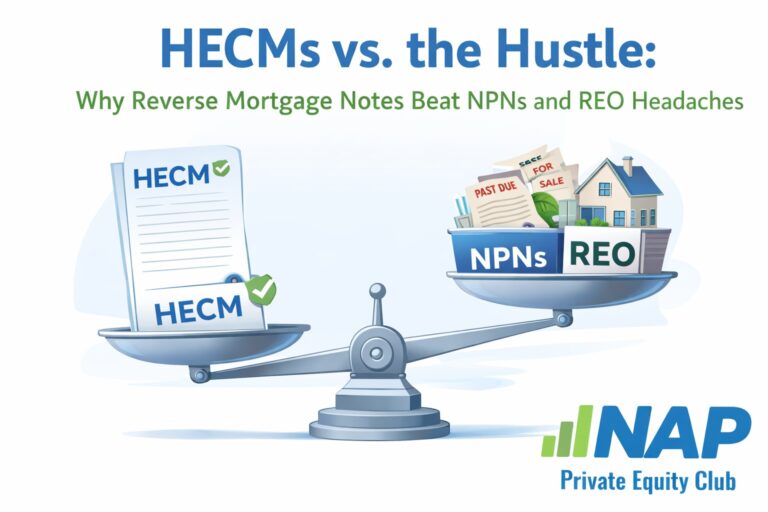
HECMs vs. the Hustle: Why Reverse Mortgages Notes Beat NPNs and REOs
In distressed investing, clarity, predictability and structure are powerful advantages. Home Equity Conversion Mortgage (HECM) loans, the federally insured reverse mortgage product, offer precisely that: a clearly defined legal and procedural framework that reduces ambiguity for investors
1. Defined Playbook with Predictable Process
Home Equity Conversion Mortgages (HECMs) operate within a clearly defined federal framework, offering investors a rare level of transparency and predictability in the distressed asset space. Unlike non-performing notes (NPNs) or direct real estate ownership—which often require navigating legal gray areas, unpredictable borrower behavior, and paperwork nightmares, HECMs follow HUD and FHA protocols from acquisition through resolution.
This structured approach minimizes uncertainty and allows investors to focus on execution rather than problem-solving. PEMCO Capital and NAP Private Equity Club collectively bring over 45 years of industry experience to this space, including more than five years of direct participation in HECM auctions. That repetition matters. Familiarity with HUD processes, counterparties, and expectations creates operational efficiency, streamlining diligence, pricing, and settlement. Over time, this experience compounds into real competitive advantage.
By investing through the RDMO family of funds, participants gain institutional access to the
HECM market, competing alongside larger players without the overhead, staffing, or learning
curve typically required. In short: fewer variables, clearer paths, and a process that behaves
more like a system than a negotiation. Predictability, in this business, is not boring—it’s
bankable
For investors, this translates into:
● Objective, non-negotiable maturity triggers (death, sale, or permanent move-out), eliminating borrower-driven uncertainty.
● Procedural resolution path that replaces subjective workouts and emotional negotiations with a mechanical, rule-based process.
● Standardized servicing and claims framework that supports consistent timelines, budgeting, and capital planning: HUD’s guarantees the paperwork and property taxes are in good shape. Offering to clear up, reimburse or buy back the note if items pop up.
● Significantly reduced legal gray areas and document variability compared to traditional NPNs or direct real estate ownership.
● More than five years of repeat participation in the HECM auction process, creating operational fluency and streamlined execution.
● Institutional access to HUD inventory through the RDMO family of funds, allows investors to compete alongside larger buyers without internal infrastructure.
● All heir redemption periods have expired on auction-acquired assets, leaving the foreclosure process uncontested. Investors may accelerate resolution through a deed-in-lieu strategy, or proceed through foreclosure efficiently with an experienced legal and servicing team in place.
● Experience at the HECM auction level matters. Repetition reduces friction, speeds closings, and minimizes operational errors that erode returns.
● Strategy designed to prioritize execution and capital efficiency over reactive problem-solving
● Cleaner portfolio management: Assets do not linger indefinitely in “workout limbo”
For investors, this translates into:
● Objective, non-negotiable maturity triggers (death, sale, or permanent move-out), eliminating borrower-driven uncertainty.
● Procedural resolution path that replaces subjective workouts and emotional negotiations with a mechanical, rule-based process
● Standardized servicing and claims framework that supports consistent timelines, budgeting, and capital planning: HUD’s guarantees the paperwork and property taxes are in good shape. Offering to clear up, reimburse or buy back the note if items pop up.
● Significantly reduced legal gray areas and document variability compared to traditional NPNs or direct real estate ownership.
● More than five years of repeat participation in the HECM auction process, creating operational fluency and streamlined execution.
● Institutional access to HUD inventory through the RDMO family of funds, allows investors to compete alongside larger buyers without internal infrastructure
● All heir redemption periods have expired on auction-acquired assets, leaving the foreclosure process uncontested. Investors may accelerate resolution through a deed-in-lieu strategy, or proceed through foreclosure efficiently with an experienced legal and servicing team in place.
● Experience at the HECM auction level matters. Repetition reduces friction, speeds closings, and minimizes operational errors that erode returns.
● Strategy designed to prioritize execution and capital efficiency over reactive problem-solving
● Cleaner portfolio management: Assets do not linger indefinitely in “workout limbo”
2. No Inventory Constraints
The Home Equity Conversion Mortgage (HECM) program was established in 1989 as a federal pilot and became permanent in 1998, making it the longest-running reverse mortgage program in the U.S. Backed by HUD and insured by FHA, HECMs have grown steadily alongside demographic trends. Since inception, over 1.3 million HECM loans have been originated nationwide, with annual originations expanding materially as the population aged 62+ has grown. Today, more than $14 trillion in U.S. home equity is held by seniors, and HECMs remain the only federally insured reverse mortgage product available to access that equity. As adoption has increased, so has downstream inventory, creating a durable, replenishing supply of assets
for investors through recurring HUD dispositions.
What this means for investors:
• Ample current supply: Large HUD auctions with thousands of HECM loans available drive consistent liquidity in the strategy.
• Repeatable pathways to inventory: Recurring HUD dispositions create a pipeline rather than a one-off event.
• Demographic tailwinds: An aging population with significant home equity underpins the broader reverse mortgage ecosystem, feeding future loan origination and eventual investor opportunities.
• Scale and diversity: National inventory pools span many markets, reducing concentration risk and enhancing portfolio construction flexibility.
• Deep historical data set: More than three decades of HECM performance, claims, and recovery data allow operators to model timelines, costs, and outcomes with greater precision, supporting disciplined underwriting and scalable portfolio construction.
3. Significantly Reduced Acquisition Risk
Margin is created at the point of acquisition. HECM acquisitions benefit from a risk profile that is materially different from traditional non-performing notes and direct real estate purchases. Assets are sourced directly through HUD auctions, where collateral files, loan balances, insurance status, and servicing history are standardized and disclosed upfront. This centralized, federally administered disposition process sharply reduces counterparty risk, pricing opacity, and adverse selection that commonly arise in fragmented secondary markets.
Because HECMs are insured by FHA, investors are not underwriting credit performance in the traditional sense. Borrower income, employment, and payment capacity are no longer variables. Instead, acquisition risk centers on property value, lien position, and procedural execution—factors that are both observable and modelable. With heirs’ redemption periods expired on auction-acquired assets, resolution paths are clear at purchase, further reducing uncertainty.
For investors, this translates into:
• Eliminated seller risk: Assets are acquired directly from HUD, removing reliance on private sellers, brokers, or distressed counterparties.
• Standardized collateral disclosure: Uniform loan files and servicing records reduce documentation gaps and post-close surprises.
• Insurance-backed downside protection: FHA insurance mitigates loss severity in defined scenarios, supporting capital preservation.
• Known resolution posture at acquisition: Expired heir rights and defined foreclosure pathways reduce legal and timing risk.
• Pricing discipline at entry: Transparent auction mechanics allow acquisitions to be priced with margin baked in, not hoped for later.
In contrast, NPN acquisitions often rely on incomplete files, seller representations, uncertain borrower engagement, and post-purchase problem solving. HECMs shift acquisition from a speculative exercise to a controlled entry point, where risk is identified, priced, and mitigated before capital is deployed.
Clear, Enforceable Timelines
One of the most underappreciated advantages of HECM assets is that timelines are defined by statute and policy, not negotiation. Once a maturity event occurs, borrower death, permanent move-out, or sale—the clock starts, and the process moves forward under HUD and
FHA guidelines.
Heirs are granted specific, time-bound options to resolve the loan. Extensions, if granted, are standardized and documented—not open-ended. When those periods expire, the asset moves cleanly into foreclosure without borrower resistance or last-minute workouts. This creates a resolution path that is sequential, observable, and enforceable.
For investors, this translates into:
• Known decision windows: Heir response periods are finite, allowing investors to plan next steps with confidence.
• Predictable transition points: Assets move from maturity → heir election → foreclosure in an orderly sequence.
• Easier capital planning: Legal, servicing, and carrying costs can be budgeted with far greater accuracy.
• Shorter average holding periods: Fewer delays tied to borrower behavior reduce timeline creep.
• Cleaner portfolio management: Assets do not linger indefinitely in “workout limbo”
In contrast, traditional NPN timelines stretch unpredictably—months or years added through stalled negotiations, repeated modifications, or borrower redefaults. HECMs replace that uncertainty with process-driven cadence.
In private credit, time is not just money—it’s risk. Clear timelines reduce both.
Conclusion — Boring Can Be Profitable
HECM loans convert many of the traditional uncertainties of distressed investing — borrower negotiations, title risk, and property operations — into a predictable, rules‑based asset class.
For investors who lack deep geographic infrastructure or ground‑level capacity, HECM assets offer:
● Lower acquisition risk due to federal pre‑processing,
● Objective payoff triggers with clear statutory remedies,
● No need to become a property operator,
● Access to structured secondary market liquidity.
In investing, stability often trumps complexity — and for many participants, HECM investments represent that “boring,” predictable source of potential return that doesn’t require competing on the front lines of distressed real estate.
For investors looking to capitalize on the advantages of HECM assets without managing the complexities themselves, RDMO Fund II, a Regulation D private offering managed by NAP Private Equity Club, provides a compelling solution. The fund is designed to leverage investor capital into a diversified portfolio of carefully underwritten HECM loans, with professional management focused on risk mitigation, scale, and consistent returns. By pooling resources through RDMO Fund II, investors gain access to institutional-grade opportunities that would be difficult to access individually — all while benefiting from a structured, scalable approach to one of the most predictable niches in the distressed debt market.
To learn more or request offering documents:
Jasmine R. Willois
Managing Partner, NAP Private Equity Club
📞 855-541-6683
📧 appts@noteassistanceprogram.com
🌐 www.napprivateequity.com